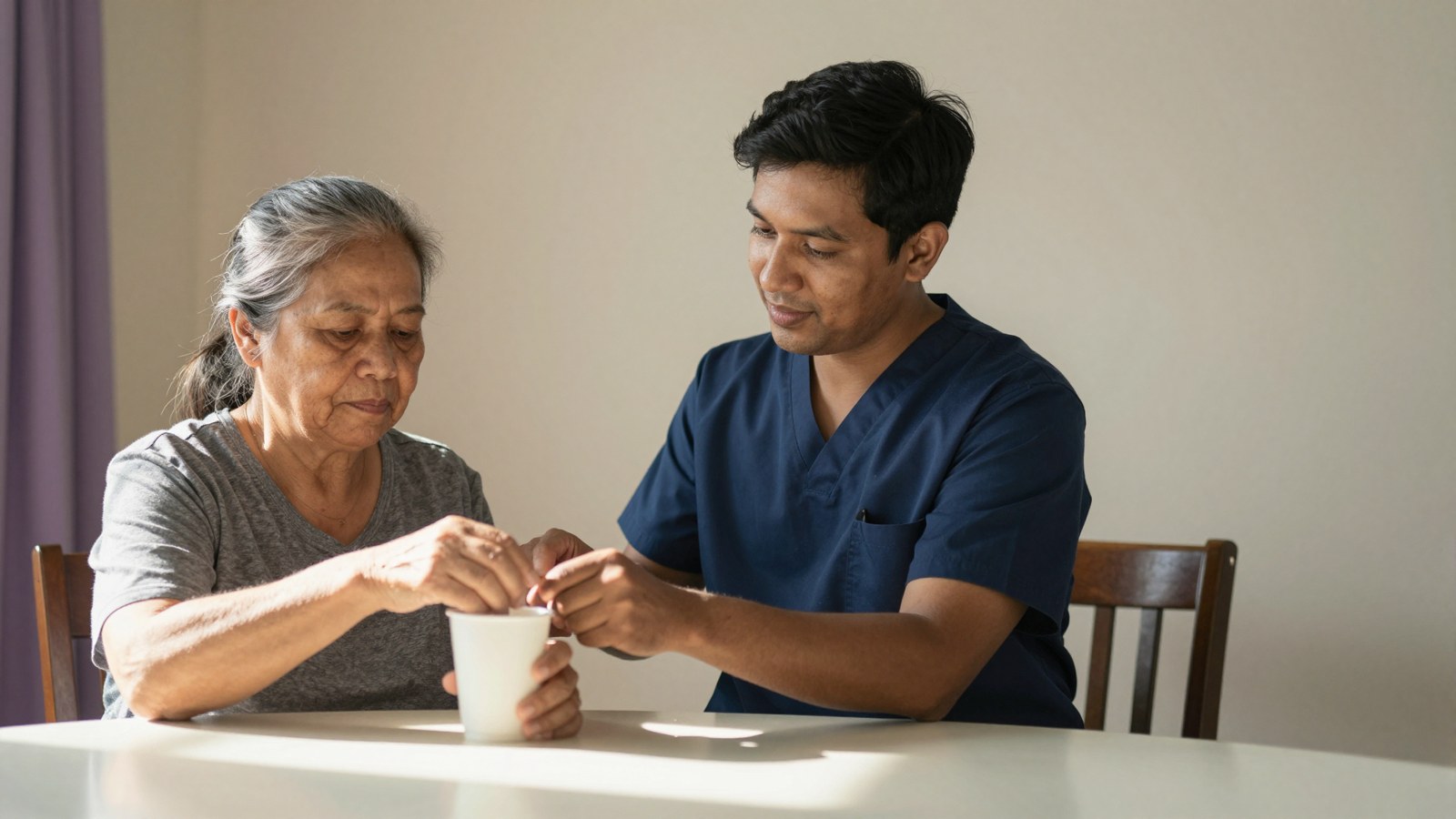
After a stroke, the work of recovery happens in the places you actually live: the kitchen, the bathroom, the hallway to the bedroom. Home health brings therapy to those places, with a nurse keeping an eye on your health along the way.
If your doctor orders it and you qualify, Original Medicare covers home health at no cost to you.
What stroke recovery can look like at home
Your dad comes home from the hospital, and the house feels different. The hallway to the bathroom seems longer. The front steps are a real climb. He needs a hand getting up from his chair, and the coffee cup goes in his left hand now, because the right one does not grip like it used to.
Words may come slowly, or the wrong word may come out. He may cough when he drinks water. He may be worn out by mid-morning and frustrated by noon. You want to help, but you are not sure when to step in and when to let him try.
All of this is common after a stroke. Home health brings therapy to the rooms where he actually lives, with a nurse watching his health along the way. Our coming home from the hospital checklist can help you get the house ready.
How home health helps
Skilled nursing
Your nurse checks blood pressure, which matters a great deal after a stroke. Together you go through the pill bottles on the counter and make sure the new medicines from the hospital match the doctor's list. Your nurse also teaches your family the warning signs of another stroke and keeps your doctor updated between office visits.
Physical therapy
The physical therapist works on standing up from a chair, walking with a walker or cane, balance, and getting up and down the front steps safely. If a leg is weak, the therapist teaches exercises to build strength and shows your family how to help without hurting your back or his.
Occupational therapy
Occupational therapy is about daily tasks. Getting dressed with one strong arm. Bathing safely with a shower chair. Making a sandwich. The therapist practices these right in your kitchen and bathroom, suggests simple tools like a long-handled sponge, and looks for hazards like loose rugs.
Speech therapy
A speech therapist helps with talking, understanding, reading, and memory. If swallowing is a problem, the therapist checks which foods and drinks are safest for him and shows you how to prepare them.
Medical social work
A stroke changes a family's plans. The social worker helps you find community resources: caregiver support groups, local transportation programs, and other programs near you.
Home health aide
While your dad is getting skilled nursing or therapy, an aide can help with bathing, dressing, and personal care. Aides are part of the skilled care plan, not a separate service.
What the first visit looks like
The first visit usually happens within 24 hours after the doctor or hospital sends the order. You can also call us first and we will coordinate the order. A nurse or therapist comes to the house and asks about the stroke, what he could do before, and what he wants to be able to do now. They check vital signs, look at medicines, and walk through the house with you to find the trouble spots, like the step into the shower.
From there, you get one named coordinator who knows your case. We send the same nurse or therapist whenever we can, and we call before every visit. If someone else must come, we call first. Our team speaks English, Spanish, Armenian, Russian, and Tagalog. Speak another language? Call us at (818) 579-4012 and ask whether we have staff who speak it. If we do not have staff who speak your language, we arrange a free interpreter.
When to call
Call 911 right away if you see signs of a new stroke: a drooping face, a weak arm or leg, slurred speech, sudden confusion or trouble understanding, sudden trouble seeing, or a sudden severe headache. Note the time it started. Also call 911 for chest pain, trouble breathing, or a fall where he hits his head or cannot get up.
Call your doctor or nurse for changes that are not emergencies but still matter: more coughing at meals, new or worse leg swelling, a blood pressure reading far outside the range your doctor gave you, a fall without injury, or a skin sore that is not healing. When in doubt, call. That is what your nurse is for.
What family can do
- Let him try. Buttoning a shirt slowly is therapy. Step in for safety, not for speed.
- Do the home exercises together. Ask the therapist to write them down, then tape the list to the fridge.
- Keep a simple log. Blood pressure, meals, and anything that worried you. Bring it to each visit.
- Clear the path. Move the hallway rug, add a night light, and keep the walker within reach of the bed.
- Take care of yourself too. Our guide on caring for a parent or spouse is a good place to start.
Cost and who qualifies: with Original Medicare, covered home health is $0 if you qualify, and your doctor decides. See what Medicare covers, who qualifies, and what is not covered.
Questions people ask
Can I get speech therapy at home?
What if my parent had the stroke months ago?
Do you speak Armenian, Spanish, Russian, or Tagalog?
Have a question about home health?
Recovering from a stroke, or caring for someone who is? Call us and we will check coverage and talk with the doctor.
(818) 579-4012Sources
This page is general information for families, not medical advice. Talk with your doctor about your situation.